The Reality of the European AI Talent Market in 2026
Artificial intelligence is no longer a localized experiment confined to research and development labs; it is an infrastructural necessity embedded across all sectors. Organizations across Europe are engaged in an unprecedented race to secure the engineering talent necessary to build,

Artificial intelligence is no longer a localized experiment confined to research and development labs; it is an infrastructural necessity embedded across all sectors. Organizations across Europe are engaged in an unprecedented race to secure the engineering talent necessary to build, deploy, and ethically govern these complex systems.
However, the supply of qualified AI professionals remains acutely constrained. Between 2016 and 2023, the number of professionals in AI-related roles more than doubled, yet they currently represent a mere 0.41% of the total EU workforce. This disproportionate ratio between exponential demand and limited available talent creates severe operational bottlenecks for enterprise scaling.
For European hiring managers and HR teams, this scarcity is the defining challenge of 2026. The traditional methods of talent acquisition are collapsing under the weight of this new reality. To survive, organizations must fundamentally rethink how they source, evaluate, and retain technical talent.
The Geopolitical and Macroeconomic Context
The competition for AI engineering talent is not merely a corporate issue; it is a geopolitical challenge.
According to a report by the Step
Up StartUps Consortium, developing, attracting, and retaining AI talent is now the defining challenge for Europe's long-term global competitiveness.
Europe currently finds itself in a precarious position. On one hand, the European Union stands out as a premier global AI education hub. According to European Commission data, 35% of all AI-related Master's programs globally are offered by universities and research centers within the EU, with Germany, France, and the Netherlands leading the charge.
Despite this educational advantage, the continent struggles with a massive brain drain. Highly skilled graduates are routinely lured away by North American technology giants offering aggressive compensation packages or fully remote working arrangements. Retaining these locally educated professionals requires a recalibration of European corporate culture and compensation structures.
The Impending Workforce Transition
The urgency of this talent acquisition crisis is underscored by broader labor market projections. According to labor economic forecasts, up to 6.5% of the EU workforce may need to transition to entirely new occupations by 2030 if AI adoption continues at its current accelerated pace.
This massive structural shift requires specialized AI engineers who can not only write complex machine learning models but also design intuitive systems that integrate seamlessly with transitioning human workforces. The engineers hired today are the architects who will dictate how successfully a company navigates this turbulent transition.
European technology hubs such as Amsterdam, Paris, Berlin, and Madrid are experiencing some of the most critical talent shortages worldwide. Even organizations with strong brand recognition and competitive compensation report increasing difficulty in hiring specialists capable of scaling AI in a responsible and commercially meaningful way.
Why Traditional Recruitment Workflows Are Failing
In a market defined by extreme scarcity, speed and precision in recruitment are paramount. Unfortunately, traditional Applicant Tracking Systems (ATS) and standard recruitment workflows are proving inadequate for identifying modern AI talent.
Traditional recruitment relies heavily on exact keyword matching and pedigree-based screening. However, the AI field is evolving so rapidly that the specific technical stack an engineer used two years ago may already be obsolete. Consequently, legacy ATS platforms frequently filter out highly capable candidates who possess the right underlying mathematical and logical foundations but lack specific, newly coined buzzwords on their resumes.
Data illustrates the cost of these outdated systems. According to Taleva, traditional ATS and keyword tools miss approximately 40% of viable mid-level and junior candidates that modern AI-driven sourcing can successfully identify. When talent is this scarce, ignoring 40% of the viable talent pool is a fatal strategic error.
The Penetration of AI in HR Workflows
To combat these inefficiencies, HR teams are aggressively adopting AI tools within their own operations. By 2026, the integration of AI into recruitment processes has shifted from experimental to standardized.
According to Taleva, 87% of companies report using AI in some form within their recruiting workflows, and 99% of hiring leaders report using AI in some capacity. These tools are primarily deployed to automate administrative burdens, with interview scheduling alone traditionally consuming 35% of a recruiter's time.
The business impact of this automation is profound. Adopters of automation fill 64% more jobs and submit 33% more candidates per recruiter. Furthermore, AI-powered chat and automated scheduling have reduced candidate response times from a sluggish seven days down to under 24 hours. In the highly competitive AI talent market, engaging a candidate within hours rather than days is often the difference between closing a hire and losing them to a competitor.
The ROI of Modernizing Talent Acquisition
The financial argument for upgrading recruitment technology is clear. According to Taleva, AI recruiting tools deliver an average Return on Investment (ROI) of 340% within 18 months of implementation.
This ROI is generated through dual mechanisms: reduced cost-per-hire and minimized vacancy costs. Recruitment costs can drop by up to 30%, and the average cost-per-hire decreases by 33% for organizations fully leveraging these systems.
More critically, these tools reduce time-to-hire by up to 50%, with some companies cutting their cycles from 27 days down to just seven days. Considering that an unfilled position costs a company an average of $500 per day in lost productivity, accelerating the hiring timeline for a critical AI engineering role translates to massive, immediate financial savings.
Navigating the Global Pay Disparity
European hiring managers face a difficult mathematical reality in 2026: competing purely on base salary against global technology companies is increasingly unfeasible. The wage premium for specialized AI skills has exploded across all industries.
According to PwC's 2025 Global AI Jobs Barometer, roles requiring AI skills carry a 56% wage premium over comparable non-AI positions. For professionals possessing multiple complementary AI competencies, that premium jumps to 43% above peers with no AI skills. This is not a gradual trend; it is a rapid market repricing.
The gap between North American and European compensation is particularly stark. According to WTW's Artificial Intelligence and Digital Talent Salary Survey, median total compensation for mid-level machine learning roles exceeds $170,000 in the United States. The Sub-Specialization Premium in EuropeWithin the European market itself, compensation varies drastically depending on the specific sub-discipline of artificial intelligence.
Organizations must understand these micro-trends to structure competitive, budget-conscious offers.
According to Techstaq, the premium applied to specific AI roles over standard software engineering salaries in Western Europe is highly fragmented. The market heavily rewards skills related to generative models and production scaling, while standardizing pay for older disciplines.
Large Language Model (LLM) and Generative AI Engineers command a 30% to 45% premium over standard software engineers, driven by companies aggressively building foundational generative AI tools. Meanwhile, AI Research Scientists command the highest theoretical premium at 35% to 50%, though these roles are largely confined to heavily funded R&D institutions.
AI Sub-Specialization
| AI Sub-Specialization | Western EU Salary Premium (vs. Standard SWE) | Primary Market Driver |
|---|---|---|
| AI Research Scientist | +35% – 50% | R&D labs and core algorithmic innovation |
| LLM / Generative AI Engineer | +30% – 45% | Aggressive enterprise adoption of conversational AI |
| MLOps Engineer | +25% – 35% | Scaling models into reliable production environments |
| Computer Vision / NLP | +20% – 35% | Localized automation and legacy data processing |
Data synthesized from current Western European tech compensation benchmarks.
Strategic Use of Retention Bonuses
Because matching US base salaries is frequently impossible, European organizations must leverage alternative financial instruments. Retention bonuses have emerged as a highly effective tool for securing critical talent during strategic organizational phases.
A retention bonus is a financial incentive, usually ranging between 10% to 30% of an employee's base salary, paid in exchange for a contractual commitment to remain with the company for a specific timeframe. These are typically classified as supplemental wages and are taxed accordingly.
From a purely financial perspective, these bonuses are highly cost-effective. The cost of losing a high-performing AI engineer goes far beyond the price of hiring a replacement. Replacing specialized technical talent can cost up to 200% of the departing employee's annual salary when factoring in lost productivity, recruitment agency fees, and onboarding time. Offering a 20% retention bonus to secure project continuity is a sound business decision.
Equity and Long-Term Incentives
Beyond cash bonuses, long-term equity incentives are becoming the primary retention lever in the European tech sector. Organizations are utilizing stock options and Restricted Stock Units (RSUs) to bridge the total compensation gap.
According to WTW compensation experts, strong growth in total pay rather than base salary alone suggests that long-term incentives are crucial for making pay packages "sticky". Employers are increasingly structuring RSUs with staggered vesting periods to align the engineer's financial upside with the long-term success of the models they are building.
When an AI engineer holds equity, they transition from a transactional employee to an invested stakeholder. This is critical for roles where the true value of an AI model may not be realized until it has been in production and iterating for several years. Equity ensures the architect remains in place to oversee the system's maturation.
The Demand for Hybrid Talent
The profile of the ideal AI professional has irreparably shifted. By 2026, companies are no longer exclusively searching for deep technical experts who operate in isolated silos. "According to Mercer's European Study on Reshaping the AI Talent Landscape, companies are searching for people who understand complex AI technologies but can also connect them directly to overarching business strategies.
These professionals must communicate technical limitations to non-technical teams and think creatively about real-world commercial applications.
Advanced coding skills in Python, Py
Torch, or TensorFlow are now viewed as a baseline entry requirement rather than a unique differentiator. Senior business leaders repeatedly highlight that curiosity, adaptability, and cross-functional collaboration are capabilities that matter just as much as advanced engineering skills.
The Danger of the Isolated Genius
Hiring managers must recognize the operational risks of employing purely technical, non-collaborative engineers. An isolated AI engineer might build a mathematically flawless machine learning model that ultimately fails in production because they never consulted the end-users.
In AI development, context is everything. An engineer must collaborate with legal departments to ensure data privacy compliance, with marketing teams to understand user experience goals, and with customer service to identify edge cases. An engineer lacking soft skills creates organizational friction and delays product launches.
This is why traditional technical interviews—which rely heavily on whiteboard coding sessions and abstract algorithmic puzzles—are failing HR teams. These assessments measure raw computational logic but completely fail to measure a candidate's ability to navigate organizational complexity, handle pushback, or pivot strategies based on business needs.
The APAC Selection Model: A Paradigm Shift in Hiring
Faced with the demand for hybrid talent, progressive European companies are abandoning purely technical screening in favor of holistic behavioral frameworks. Radical Recruitment operates on a specialized framework tailored for the modern tech landscape: the APAC Selection Model.
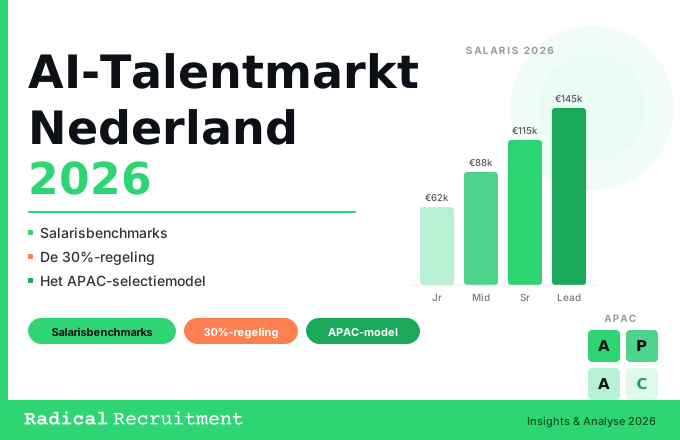
The APAC model evaluates candidates across four critical human dimensions: Attitude, Potential, Ability, and Culture. By systematically assessing the whole person, organizations can identify hidden potential, ensure long-term retention, and build resilient engineering teams capable of navigating continuous technological disruption.
This approach aligns with current market realities. According to Taleva, 85% of top firms now prioritize demonstrated skills and behavioral competencies over traditional academic degrees. The APAC model provides a structured methodology for measuring these critical, non-technical indicators of success.
Pillar 1: Attitude
In the rapidly fragmenting landscape of artificial intelligence, a positive, resilient attitude is the most accurate predictor of an engineer's long-term utility. The AI sector is characterized by intense ambiguity, frequent project pivots, and inevitable model failures.
Attitude, in this context, refers to how an engineer approaches problem-solving and handles professional adversity. Hiring managers must design interview questions that probe a candidate's response to failure. Asking candidates to detail a time their code caused a critical issue, and dissecting how they communicated that failure to stakeholders, provides profound insight into their professional maturity.
An engineer with the right attitude views failure as a necessary stepping stone in the algorithmic optimization process.
Pillar 2: Potential
Given the velocity of AI advancement, hiring for past experience is essentially hiring for obsolete knowledge. The World Economic Forum estimates that 44% of workers' skills will likely need to change within the next five years. In the AI sub-sector, this timeline is significantly compressed.
Therefore, HR teams must hire for Potential—specifically, the velocity at which an engineer can learn, unlearn, and synthesize new information. A candidate who has spent five years mastering a legacy natural language processing technique is less valuable than a candidate who has demonstrated the ability to teach themselves three new generative frameworks in the past six months.
To measure potential, organizations should utilize situational assessments that present candidates with novel, unfamiliar problems outside their immediate domain expertise. The goal is not to see if they know the answer immediately, but to observe the strategic framework they use to acquire the necessary information and formulate a hypothesis.
Pillar 3: Ability
While Attitude and Potential are critical, they must be anchored by concrete technical Ability. However, the APAC model contextualizes ability differently than traditional recruitment frameworks. It evaluates technical competence through the lens of business application.
Ability is not just about writing clean, efficient code; it is about selecting the right architectural approach for a specific business problem. For example, according to EY, organizations are currently split on their AI infrastructure approaches: 41% primarily use closed proprietary models, 27% use open models, and 26% use a hybrid approach.
An engineer's Ability is demonstrated by their capacity to advise leadership on which model to choose. Can they weigh the trade-offs between the lower costs of an open-source model and the immediate power of a closed model? During interviews, candidates should be presented with a business problem and a strict budget, forcing them to justify their technical architecture choices against commercial constraints.
Pillar 4: Culture
The final pillar, Culture, does not mean finding candidates who look, think, or act like the existing team. Rather, it focuses on alignment with the organization's core values, ethical boundaries, and working methodologies.
In 2026, values-driven employment is gaining massive traction. According to Guidant Global, more APAC and European professionals now heavily consider a company's Environmental, Social, and Governance (ESG) principles and Corporate Social Responsibility (CSR) initiatives when choosing an employer. AI professionals want to know that the tools they build will be deployed ethically.
Cultural assessment involves ensuring the candidate thrives in the organization's specific operational environment. Do they require rigid, top-down instruction, or do they flourish in highly autonomous, decentralized teams? Useful personality testing tools and behavioral interviewing techniques can highlight these alignments, ensuring the candidate will add sustained value to the organizational culture.
Recruiting Under the Shadow of the EU AI Act
Attracting top AI talent in Europe requires an environment that is not just technically stimulating, but legally resilient. The implementation of the European Union Artificial Intelligence Act (AI Act) is profoundly altering the recruitment landscape, creating massive compliance burdens but also unique employer branding opportunities.
The regulatory timeline is strict. The AI Act officially entered into force in August 2024 and becomes fully applicable on August 2, 2026. However, the legislation contains crucial nuances for HR professionals and hiring managers regarding the tools they use to acquire talent.
The 2027 Horizon for High-Risk HR Systems
Under the AI Act, systems utilized in employment, worker management, and access to self-employment—which explicitly includes AI recruiting software and automated CV screeners—are classified as "high-risk" systems.
Following recent political agreements to simplify implementation, the specific rules governing high-risk AI systems used in employment will apply from December 2, 2027. This extension provides European HR teams a defined, critical runway to completely audit and overhaul their internal talent acquisition technology stacks.
The stakes for non-compliance are existential. The Act mandates strict human oversight mechanisms, rigorous bias mitigation protocols, and comprehensive data governance. Failure to comply can result in catastrophic financial penalties, reaching up to €35 million or 7% of a company's global annual turnover.
The Employer Branding Opportunity
While many organizations view the EU AI Act purely as a bureaucratic hindrance, forward-thinking HR leaders are utilizing compliance as an offensive recruitment strategy. Top-tier AI engineers are inherently sensitive to data privacy, algorithmic fairness, and ethical technology deployment.
According to candidate experience statistics, 79% of candidates want absolute transparency when AI is used in the hiring process. When a candidate applies for an AI engineering role, they are judging the company based on the sophistication and ethics of the recruitment tools they interact with.
By proactively adopting GDPR-compliant, AI Act-ready sourcing platforms, companies signal to prospective talent that they take ethical AI seriously. When a company can publicly demonstrate that its internal models are transparent, unbiased, and legally compliant, it builds immediate psychological trust. Engineers want the freedom to innovate within safe, well-governed architectural boundaries, rather than spending their time retroactively fixing non-compliant, biased legacy systems.
The Amsterdam Microcosm: A Case Study in European Hubs
To understand the broader European talent market, one must examine the dynamics of its leading technology hubs. Amsterdam serves as a perfect microcosm of the opportunities and structural challenges facing AI recruitment in 2026.According to the State of Dutch Tech 2026 report, the Netherlands' tech sector remains formidable, boasting over 11,301 active tech companies. The ecosystem collectively raised €2.64 billion in venture capital in 2025, confirming sustained participation from both domestic and international investors.
Amsterdam is home to highly funded AI startups across various sub-sectors. For example, Synthesia (NL/UK) raised an $89M Series D, while health-tech AI firm Aidence secured a $34M Series B. This concentration of capital creates hyper-competition for local talent, driving up salaries and forcing companies to innovate their retention strategies.
The Scale-Up Challenge
Despite this headline growth, Amsterdam highlights a critical European weakness: the scale-up bottleneck. The State of Dutch Tech report notes that the share of startups that successfully move on to attract significant growth funding—the scale-up ratio—was only 21.6% in 2025.Furthermore, the number of early-stage funding deals has fallen, making it harder for new founders to secure initial investment before achieving product-market fit. Deeptech companies, those working on advanced specialized computing, account for only 12% of tech firms but a much larger share of successful scale-ups.
For HR teams in Amsterdam and similar hubs like Berlin or Paris, this data dictates strategy. Because early-stage funding is tight, startups cannot afford to make poor hiring decisions. Every AI engineer hired must possess the Attitude and Potential to directly influence product-market fit. Conversely, well-funded scale-ups must focus heavily on the Ability and Culture pillars of the APAC model to ensure stable growth without fracturing the company's foundational values.
Implementing a Borderless Talent Strategy
Given the fierce local competition within hubs like Amsterdam, relying solely on a localized talent pool is a recipe for stagnation. Organizations are increasingly adopting borderless talent models to sustain their AI development pipelines.
According to EY, regulatory fragmentation and geopolitical uncertainty mean that "sovereignty" now spans where talent resides and where compute happens. However, the European Union's freedom of movement allows organizations to tap into emerging tech hubs across Eastern and Southern Europe.
By offering flexible, remote, or hybrid arrangements, companies in expensive hubs like Amsterdam can attract brilliant engineers located in regions with a lower cost of living. This strategy allows organizations to offer highly competitive compensation packages relative to the engineer's local market, without matching the exorbitant base salaries demanded in Silicon Valley or London.
Building an Unbeatable Retention Architecture
Attracting an AI engineer is only the first phase of a successful talent strategy. In an industry defined by intense poaching and high turnover, retention is a direct revenue driver. European companies must build internal environments where highly sought-after AI talent organically chooses to remain for the long haul.
If an organization simply inserts a modern AI engineer into a rigid, legacy corporate structure, that engineer will inevitably leave within twelve months. Retention in 2026 requires psychological safety, continuous intellectual stimulation, and deep alignment with corporate purpose.
Designing a Culture of Purpose
Beyond compensation, the fundamental motivators for highly skilled tech workers have evolved dramatically. Post-pandemic shifts have made flexibility, well-being, and organizational purpose central to job decisions.
Values-driven employment is not a buzzword; it is a retention metric. More professionals now deeply consider a company's Environmental, Social, and Governance (ESG) principles, including sustainability and Corporate Social Responsibility (CSR) initiatives. AI engineers are highly aware of the societal impact of the technologies they build.
They want assurance that their machine learning models will contribute to societal resilience and efficiency, rather than being used for exploitative practices.
Organizations that actively invest in ethical AI development and demonstrate clear alignment with global sustainability goals possess a distinct retention advantage. When an engineer's personal values align seamlessly with the organizational mission, the likelihood of attrition to a higher-paying competitor decreases substantially.
Fostering Psychological Safety and Experimentation
The fastest way to lose an elite AI engineer is to trap them in monotonous maintenance tasks or punish them for failed experiments. According to Mercer's interviews with senior leaders across Europe's major economic hubs, AI professionals actively demand the space to experiment, learn, and tackle meaningful, novel challenges.
Retention is heavily dependent on a company's commitment to psychological safety. When an organization utilizes the APAC Selection Model to hire for Attitude, they bring in engineers who are eager to push boundaries. If leadership then penalizes these engineers when a novel algorithmic approach fails, trust is instantly destroyed.
Flexible work models and visible leadership support play a vital role here. Many organizations report that professionals in these roles stay for the work they can do and the environment they can grow in. Incorporating "innovation sprints"—dedicated weeks where engineers are free to work on passion projects or test new open-source models without the pressure of strict product deadlines—is a highly effective structural retention tool.
The Imperative of Continuous Upskilling
Finally, organizations must recognize that the AI literacy of their entire workforce impacts the retention of their specialized engineers. The EU AI Act now requires employers to ensure staff have sufficient AI literacy, meaning broad organizational training must become standardized.
When general staff are AI-literate, the specialized AI engineers spend less time explaining basic concepts and more time doing high-level architectural work. Furthermore, the engineers themselves require continuous upskilling. Employers who provide dedicated budgets for engineers to attend global conferences, pursue advanced certifications, or experiment with cutting-edge hardware will see significantly higher loyalty and lower turnover.
Conclusion: Strategic Imperatives for HR Leaders
The 2026 European AI labor market is fraught with challenges: an acute structural deficit of talent, rapidly escalating compensation premiums, and an increasingly stringent, high-stakes regulatory environment. To navigate this complex landscape successfully, hiring managers and HR teams must definitively abandon legacy recruitment playbooks.
Relying solely on base salary negotiations and algorithmic resume screening based on outdated keywords is a guaranteed path to talent acquisition failure. To secure and retain the AI engineers capable of driving long-term corporate innovation, organizations must take immediate, concrete action:Overhaul the Assessment Framework: Discard purely technical, siloed interviews. Implement the APAC Selection Model to evaluate candidates based on Attitude, Potential, Ability, and Culture.
This ensures the acquisition of resilient, hybrid talent capable of bridging the gap between raw code and strategic commercial realities.
Modernize Total Rewards: Acknowledge the impossibility of matching US base salaries. Instead, audit current compensation bands against 2026 sub-specialization data and implement staggered Restricted Stock Units (RSUs) alongside 10-30% retention bonuses to secure critical talent.
Proactively Audit for AI Act Compliance: Do not wait for the December 2027 deadline regarding high-risk HR systems. Immediately transition to GDPR-compliant, unbiased AI sourcing tools and aggressively market your ethical AI governance as a core pillar of your employer branding.
Institutionalize Experimentation: Restructure internal workflows to guarantee AI engineers have dedicated time, psychological safety, and infrastructural resources for continuous experimentation and upskilling, ensuring they do not stagnate or burn out in maintenance roles.
By integrating human-centric behavioral psychology with creative compensation strategies and ethical technological governance, European companies can successfully attract, engage, and retain the elite AI engineering talent necessary to lead the global technological future.
Frequently asked questions
Sources
- European Policy Centre— epc.eu ↗
Tell us what you need.
We respond within 24 hours, from a real human.
Get in touch